

Hello everyone, I am the assistant of Australian Encyclopedia. Recently, some friends asked me aboutWhat did Britain do in Australia?Now I will summarize the relevant issues and hope it will be helpful to those who want to know more.
The relationship between Britain and Australia has a long and complex history. From Captain Cook's discovery of Australia's east coast in 1770, to the First Fleet's arrival at Port Jackson in 1788 to establish a penal colony, and then to the formation of the Commonwealth of Australia in 1901 and its gradual path to independence, Britain's colonial history in Australia has profoundly shaped the country's political, economic, cultural, and social structure. Even today, as a multicultural nation, the legacy of Britain remains evident throughout Australia. This article will systematically examine Britain's role in Australia from multiple perspectives, including history, law, education, immigration, business, and language, to help you gain a comprehensive understanding of this Southern Hemisphere nation.
The historical process of British colonization of Australia
Britain's actions in Australia began with colonial expansion. In the late 18th century, to alleviate overcrowded prisons at home and to establish a strategic foothold in the South Pacific, Britain decided to use Australia as a penal colony. On January 26, 1788, the First Fleet landed in Sydney Harbour, and Captain Phillip raised the British flag; this day later became Australia Day. Over the next 80 years, Britain sent approximately 160,000 convicts to Australia, while also bringing free immigrants, soldiers, and officials. Through policies such as the Australian Land Act, the British government massively expropriated land from Indigenous Australians, implementing the "terra nullius" theory, leading to a sharp decline in the Indigenous population. This historical trauma continues to affect the rights claims of Australian Indigenous peoples. In the mid-19th century, the discovery of gold in Victoria led to a surge in British immigration, and Australia gradually transformed from a penal colony into a prosperous colony. From 1855 onwards, colonies such as New South Wales and Victoria gained responsible governments, and Britain began to gradually relinquish power. In 1901, the six British colonies united to form the Commonwealth of Australia, but the British monarch remained the head of state, and the Privy Council Judicial Committee was retained as the highest court of appeal. It wasn't until the passage of the Australia Act in 1986 that the British Parliament completely terminated its legislative power over Australia. Following the failed republican referendum in 1999, the British monarch remains Australia's de facto head of state.
The transplantation of British law and political system in Australia
One of the most significant contributions Britain made to Australia was the transplantation of the Westminster system's political and legal framework. While Australia's constitution is a written law, its operation is deeply rooted in British parliamentary sovereignty, the rule of law, and common law traditions. Australian High Court precedents frequently cite decisions from the British House of Lords and Privy Council, and Australia only gradually established its independent judicial finality in 1975. Today, Australia retains a Governor-General as the representative of the British monarch, and each state has its own governor. The legal system's concepts of "reasonable doubt," "jury trial," and "adversarial proceedings" all originate from Britain. Furthermore, the land ownership system introduced during the British colonial period (such as the Torrens Register) remains the foundation of Australian real estate transactions. Even modern Australia's welfare state ideals are heavily influenced by the 1942 Beveridge Report. It can be said that Britain established an efficient and stable legal environment in Australia, a crucial reason why Australia attracts immigrants and businesses.
The influence of Britain on the Australian education system
The British influence on Australian education is most evident in the school system and curriculum. Australia's oldest universities—the University of Sydney (1850) and the University of Melbourne (1853)—were both modeled after Oxford and Cambridge. Even today, the collegiate system, tutorial system, and degree grading (Honors Bachelor's, Master's, Doctoral) in Australian universities still bear strong British influences. Primary and secondary education also draws on the British public school tradition, with many private grammar schools still retaining their uniforms, crests, and sports competitions. Furthermore, with English as the official language, the literary classics taught in education still primarily focus on Shakespeare and Dickens. In recent years, the Australian study abroad market has flourished, with a large number of Chinese students choosing to study in Australia.Undergraduate studies in AustraliaMany of these programs (including master's programs) are drawn to Australia's education system because it inherits the British tradition of rigor and innovation. The educational "genes" left by Britain in Australia have earned Australian degrees high international recognition, while also attracting numerous British teachers to teach in Australia, fostering a two-way exchange.
British immigration and its impact on Australia's demographic structure
The most direct action Britain took in Australia was sending a large influx of British immigrants. After World War II, Australia implemented the "White Australia Policy," prioritizing British immigrants and even providing subsidized ferry tickets. Statistics show that between 1945 and 1970, over one million British people immigrated to Australia, making people of British descent the largest ethnic group in the country. These immigrants brought with them architectural styles (Victorian terraced houses, Tudor Revival villas), dietary habits (fish and chips, meat pies, afternoon tea), holiday traditions (Queen's Birthday, Easter, Christmas customs), and sporting preferences (cricket, rugby, tennis). Although the "Multicultural Policy" replaced the "White Australia Policy" after the 1970s, the descendants of British immigrants still hold dominant positions in politics, business, and media. Even today, Britain remains Australia's second-largest source of immigrants (after India), with tens of thousands of young Britons visiting Australia annually on working holiday visas. British communities have formed distinct British lifestyles in cities like Sydney, Melbourne, and Perth; for example, Paddington Market in Sydney and Victoria Market in Melbourne retain a strong British atmosphere.
Britain's Legacy in Australian Business and Economy
Britain's role in Australian commerce is primarily reflected in early capital investment and trade networks. In the 19th century, British banks (such as the Bank of Australia, the predecessor of ANZ), insurance companies, and mining companies were among the first to enter Australia, controlling the export of wool, gold, and wheat. Two of Australia's four largest banks today (Commonwealth Bank of Australia and ANZ) have deep ties to British capital. Furthermore, British colonists introduced the cornerstones of the Australian economy—livestock farming (Merino sheep), viticulture, and mining technology. Britain was also Australia's largest trading partner and source of investment for a long period, until it was surpassed by Japan and China in the late 20th century. Modern Australian business law, including corporate governance and accounting standards (which align with International Financial Reporting Standards but retain British characteristics), is modeled after the British system. Many well-known Australian companies, such as Rio Tinto, are themselves Anglo-Australian joint ventures. Britain's actions in Australian commerce established an open market economy system accessible to the world, a key reason why Australia attracts international businesspeople to settle and invest.
British genes in English and daily life
Language is the most obvious imprint. While Australian English has its own unique accent and slang, its spelling, grammar, and core vocabulary are all derived from British English (for example, using "colour" instead of "color," and "centre" instead of "center"). Although the official system of measurement in daily life has shifted to the metric system, imperial units are still commonly used in spoken language (e.g., feet for height, pounds for weight, and miles for distance). Furthermore, Australia's traffic rules (driving on the left), postal system (red mailboxes), and drinking culture (pubs, liquor license system) all follow British influence. Even character traits such as "queueing culture," "apology culture," and "sarcasm and humor" are considered to be heavily influenced by Britain. Of course, Britain has also done many "bad" things in Australia: environmental destruction, invasive species (such as rabbits and foxes), and the destruction of Indigenous livelihoods. But undeniably, Britain has profoundly shaped the modern face of Australia over more than two centuries.
Questions related to what the UK did in Australia
Question 1: Does the British colonial system in Australia still exist today?
Although Australia is politically independent, remnants of the British colonial system remain visible. The most prominent example is the Australian monarchy: King Charles III remains the head of state, with the Governor-General acting in his stead. Furthermore, the Union Jack remains in the upper left corner of the Australian flag, and the national anthem, "Go Australia!", only replaced "God Save the Queen" in 1984. Legally, Australian citizens automatically possess British "Overseas Citizen" status (although they do not enjoy EU benefits), and Australia remains part of the Commonwealth. However, a growing number of Australians support abolishing the monarchy and establishing a republic. Following the failed republican referendum in 1999, Charles III's accession to the throne in 2022 reignited the debate, but symbols of the British monarchy will likely persist in the short term.
Question 2: What special impact does the UK have on studying in Australia?
The UK has directly influenced the assessment system and international recognition of Australian higher education. Seven of Australia's Group of Eight universities were founded during the colonial period, and their academic traditions are similar to those of the Russell Group in the UK. Australian universities generally use the British degree classification system (first-class honors, second-class honors, etc.), and their curricula emphasize critical thinking and independent research. For international students, degrees earned in Australia can be used to apply for jobs with British companies (due to mutual recognition of Commonwealth degrees) or for Australian skilled migration. Compared to the high tuition and living costs in the UK, studying in Australia offers better value for money, and graduates can obtain a 2-4 year work visa. If you are considering...Undergraduate studies in AustraliaIt's important to note that British education emphasizes group discussions, essay writing, and presentation skills, which differs significantly from the exam-oriented education system in China. It is recommended to adapt to an English-speaking environment in advance and familiarize yourself with the academic integrity guidelines of Australian universities.
Question 3: How has the UK’s immigration policy in Australia evolved?
The UK has dominated Australia's immigration policy since World War II. The initial "White Australia" policy explicitly discriminated against non-whites, welcoming only British and European immigrants, even offering free land or employment subsidies. Australia abolished the "White Australia" policy in the 1960s and began promoting multiculturalism in 1973. British immigrants no longer enjoy special privileges, but British citizens can still apply for fast-track visas (such as the "UK Ancestry Visa") based on their British ancestry. In recent years, the natural advantages of British qualifications and native English speaking skills remain in Australia's skilled migration points system. Many young British people come to Australia on working holiday visas and then switch to student visas or employer sponsorships. Furthermore, Australia signed a free trade agreement with the UK after 2020, further easing work visa restrictions for young people from both countries.
Question 4: What are the everyday manifestations of British culture in Australia?
The most obvious difference is in the food: English breakfasts (bacon, eggs, beans, roasted tomatoes), meat pies, and fish and chips are ubiquitous; hot cross bread and Christmas pudding are also British traditions. In sports, cricket is Australia's national sport, and the annual Ashes Cup series between Australia and Great Britain is a major sporting event; rugby (Russian Football League) is also extremely popular. Linguistically, Australians often use British expressions like "mate," "bloody," and "cheers." In architecture, Sydney's Queen Victoria Building (QVB) is a typical example of English Byzantine Revival style, and Melbourne's Flinders Street Station is also imbued with British colonial influence. Furthermore, the British passion for horse racing (Melbourne Cup) and garden culture are also integral parts of Australian life.
Question 5: How should we view the negative role Britain played in Australian history?
It must be acknowledged that British colonists brought disastrous consequences to Australia's Aboriginal people. In the 18th and 19th centuries, through forced expulsion, the spread of disease, and coercive assimilation (the "Stolen Generations"), the British caused the Aboriginal population to plummet from an estimated one million to 90,000 by 1900. Aboriginal land was seized, and their language and culture became endangered. It wasn't until the latter half of the 20th century that the Australian government began to apologize and offer compensation (Prime Minister Kevin Rudd formally apologized in 2008). Furthermore, the introduction of alien species such as rabbits, foxes, and feral cats by the British colonists severely damaged Australia's fragile ecosystem. These historical wounds remain issues that Australian society must confront today. While criticizing British colonization, it is also important to recognize that the modern Australian government is actively working to restore Aboriginal rights, promote racial reconciliation, and commit to environmental protection. For immigrants, understanding this history helps to gain a more comprehensive understanding of the diversity and inclusivity of Australian society.
In conclusion, Britain's actions in Australia are a double-edged sword: they laid the foundation for modern Australian politics, law, education, and economy, but also left the scars of colonial plunder. Today, Australia is an independent, multicultural nation, but British influence still permeates every corner—from driving on the left on the road to the Speaker's gavel in Parliament, from English tea in supermarkets to Shakespeare classes in schools. If you are planning to immigrate to Australia or send your children to study there, understanding this history will help you integrate into local society more quickly. Best wishes for a wonderful life in Australia!
Thank you for your reading. I hope this article can help you understandWhat did Britain do in Australia?From history to modern times, from law to daily life, this will give you a deeper understanding of this beautiful country in the Southern Hemisphere.
转载请注明:AU6001.COM – Australia Chinese Encyclopedia » The British Legacy in Australia: Profound Impacts from Colonial History to Modern Life
 简体中文
简体中文 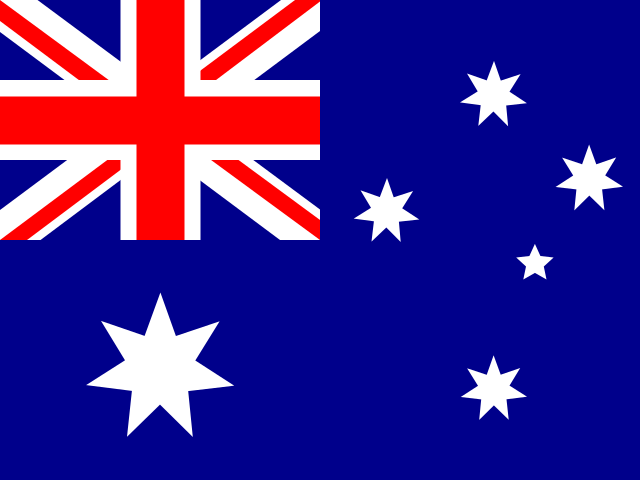 English (Australia)
  香港中文
香港中文